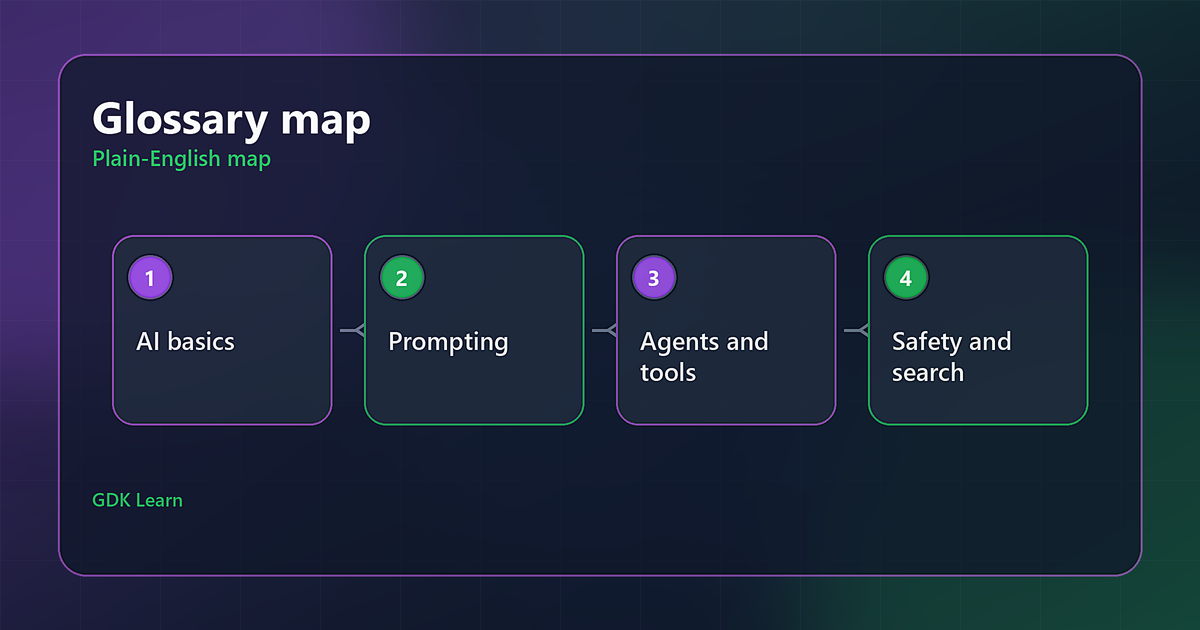
AI basics
- AI model
- Software trained on lots of examples so it can recognize patterns and produce useful output from what you give it.
- Why it matters: the model is the engine, not the whole car. A product is the model plus everything wrapped around it.
- In plain terms: like a very well-read intern who has read almost everything and can draft almost anything, but still needs direction and checking.
- Large language model (LLM)
- A model trained on huge amounts of text so it can read, rewrite, summarize, and generate language.
- Why it matters: this is what sits behind ChatGPT, Claude, Gemini, and most AI tools you have heard of.
- In plain terms: autocomplete that grew up, went to college, and can now hold a conversation.
- Generative AI
- AI that creates new things: text, images, audio, code, or video, rather than just sorting or scoring existing data.
- Why it matters: it is the shift from "AI that predicts" to "AI that produces," which is why it suddenly feels useful for everyday work.
- In plain terms: older AI could tell you an email looked like spam. Generative AI writes the email.
- Multimodal model
- A model that handles more than one kind of input, such as text plus images, audio, or video.
- Why it matters: it lets you do things like hand the AI a photo of a receipt or a screenshot and ask about it.
- In plain terms: instead of only reading, it can also look and listen.
- Token
- A small chunk of text the model reads or writes, usually a word or part of a word.
- Why it matters: tokens are what you pay for and what fill up the model's working space, so they drive both cost and length limits.
- In plain terms: the model reads in puzzle pieces, not whole sentences. "Unbelievable" might be three pieces.
- Context window
- The maximum amount of text a model can hold in mind at once for a single request, including your input and its answer.
- Why it matters: a bigger window lets the AI consider more at once, but a full window is not the same as good memory. Old details still get crowded out.
- In plain terms: the desk it works at. A bigger desk holds more papers, but pile on too many and it loses the one that mattered.
- Knowledge cutoff
- The rough date after which a model has not learned about new events, unless it can look things up with a tool.
- Why it matters: it is why an AI can confidently give you last year's answer to a this-year question.
- In plain terms: like someone who has been off the grid since a certain date and does not know what they missed.
- Inference
- The act of running the model to get an answer. Every response is one inference.
- Why it matters: each inference has a cost and a wait time, which adds up fast when an agent runs many steps.
- In plain terms: training is teaching the model. Inference is asking it a question and getting the reply.
- Prompt
- The instructions and information you send to the model to get a response.
- Why it matters: the quality of what you ask sets a ceiling on the quality of what you get back.
- In plain terms: the difference between "write something about our business" and a clear brief is the difference between a shrug and useful work.
- Temperature
- A setting that controls how varied or predictable the model's output is.
- Why it matters: lower is steadier and more repeatable. Higher is more varied and creative, and less reliable.
- In plain terms: a dial from "give me the safe, expected answer" to "surprise me."
- Hallucination
- When an AI states something false with full confidence, as if it were fact.
- Why it matters: it is the single biggest reason to check AI output before trusting it on anything that counts.
- In plain terms: like a confident new hire who gives you a precise answer they completely made up. Usually right, sometimes badly wrong, never sounds unsure.
- Fine-tuning
- Further training a model on your own examples so it gets better at a specific job or voice.
- Why it matters: it is one way to specialize a model, though for most business needs a good prompt or a skill is cheaper and faster.
- In plain terms: sending a capable generalist to a short course on exactly how your shop does things.
- Chatbot
- An AI you talk to that answers your messages and stops there.
- Why it matters: it is the baseline a lot of AI gets compared to. An agent goes further: it works toward a goal and takes actions, where a chatbot just replies.
- In plain terms: a helpful front desk that answers questions but does not get up and do the task for you.
- Reasoning model
- A model built to work through harder problems step by step before answering, instead of replying instantly.
- Why it matters: it is a product category buyers now see advertised. It can be better on multi-step problems, but it is slower and costs more, so it is not always the right pick.
- In plain terms: the difference between blurting an answer and taking a minute to think it through first.
- Open vs closed model
- An open (open-weights) model can be downloaded and run yourself; a closed model is used through a company's hosted service or API.
- Why it matters: it affects privacy, cost, control, and lock-in. Open gives you more control and self-hosting; closed is usually easier and more capable out of the box.
- In plain terms: owning the espresso machine versus buying coffee from the shop. One is more control, one is more convenience.
- Cost per token (token-based pricing)
- Most AI tools charge by the token, the small chunks of text going in and out, often with a different price for input and output.
- Why it matters: it is how AI spend actually adds up. Long inputs, chatty outputs, and multi-step agents all cost more, which is why limits matter.
- In plain terms: like a taxi meter that ticks for every word read and written, not a flat fare.
- API / API key
- An API is a clean, machine-to-machine doorway one piece of software uses to talk to another; an API key is the password that lets it through.
- Why it matters: it is how AI tools connect to your other software behind the scenes, and the API key is a secret you guard like any password.
- In plain terms: the staff-only service door between two businesses, and the badge that opens it.
- Latency
- How long an AI takes to respond.
- Why it matters: it shapes whether an AI feels snappy or sluggish, and it stacks up fast in agents that take many steps.
- In plain terms: the pause between asking and getting an answer back.
Prompting and context
- Prompt engineering
- The craft of writing instructions, examples, and rules that get reliably good output from a model.
- Why it matters: small changes in how you ask can be the difference between a usable answer and a useless one.
- In plain terms: learning how to brief the AI the way you would brief a sharp but very literal new hire.
- Context engineering
- Designing the whole information environment around the model: what facts, files, and history it can see when it answers.
- Why it matters: giving the model the right context usually beats clever wording. The best prompt cannot fix missing information.
- In plain terms: setting the AI's desk with exactly the right files before you ask the question.
- Few-shot prompting
- Showing the model a few examples of the task and the answer style you want before asking it to do the real one.
- Why it matters: examples often teach the model your format faster than a paragraph of instructions.
- In plain terms: "here are three good ones we wrote, now do the fourth like these."
- Zero-shot prompting
- Asking the model to do a task with no examples, just the instruction.
- Why it matters: it is fast and often good enough, but for picky formats, examples beat going in cold.
- In plain terms: handing someone a task with no sample and trusting they get the gist.
- Chain-of-thought
- Prompting the model to work through its reasoning step by step instead of jumping straight to an answer.
- Why it matters: it tends to improve accuracy on problems that need a few logical steps.
- In plain terms: asking someone to show their work instead of just blurting the final number.
- System message
- The high-priority instructions that set how the AI should behave and what limits apply, sitting above your individual requests.
- Why it matters: it is where a tool's personality, rules, and guardrails live.
- In plain terms: the standing instructions taped to the desk that apply no matter what today's task is.
- Instruction hierarchy
- The order of authority among the different instructions a model receives: system rules first, then the app, then your request, then anything from tools or web pages.
- Why it matters: it is the backbone of keeping an AI safe, since content pulled from the web should never outrank your actual instructions.
- In plain terms: the chain of command. A note found on a website does not get to override the boss.
- Structured output
- Model output shaped to a fixed structure, such as JSON or a table, instead of free-form prose.
- Why it matters: it lets other software read the answer reliably, which is essential for automations.
- In plain terms: asking for the answer on a form with labeled boxes, not a handwritten paragraph.
- Schema
- A formal description of the fields, types, and shape that data or output is expected to follow.
- Why it matters: a clear schema is how you stop an automation from breaking when the AI returns something in the wrong shape.
- In plain terms: the blank form's layout: name here, date there, amount in this box.
- Grounding
- Anchoring a model's answer to specific provided sources or facts rather than its general memory.
- Why it matters: grounded answers are easier to trust and check, because you can see what they are based on.
- In plain terms: "answer from these documents," not "answer from whatever you remember."
- Citation
- A pointer to the source an answer is based on.
- Why it matters: citations turn a confident claim into a checkable one, which is the whole game with AI you rely on.
- In plain terms: "says who?" answered with a link instead of a shrug.
- Context rot
- When a model's working context grows so long that stale, conflicting, or irrelevant details start steering it badly.
- Why it matters: it explains why a long chat session can slowly get worse, not better, and why starting fresh sometimes helps.
- In plain terms: a desk so buried in old papers that the AI keeps grabbing the wrong one.
Agents, tools, and skills
- Agent
- Software that takes a goal and works toward it across several steps, using tools and deciding what to do next on its own.
- Why it matters: it is the difference between a chatbot that answers and a system that goes and does the task.
- In plain terms: a chatbot tells you how to book the trip. An agent books it.
- Agentic
- A description of how much a system acts on its own through planning, tools, and iteration, rather than answering in one shot.
- Why it matters: "agentic" is a spectrum, not a yes-or-no. Most useful systems are only a little agentic, and that is fine.
- In plain terms: the more a tool decides and acts for itself, the more agentic it is.
- Workflow
- A mostly predefined sequence of steps the AI runs in a set order.
- Why it matters: when the steps are always the same, a plain workflow is cheaper and more reliable than a full agent.
- In plain terms: a recipe. Same steps, same order, every time.
- Tool
- An outside capability a model can use, such as web search, a calculator, a database, or sending an email.
- Why it matters: tools are what let an AI act in the real world instead of only talking about it.
- In plain terms: the model is the worker. Tools are the phone, the filing cabinet, and the calculator on the desk.
- Function calling
- The structured way a model asks the software to run a specific tool with specific inputs.
- Why it matters: it is the plumbing behind almost every AI feature that does something beyond chatting.
- In plain terms: the model filling out a request slip: "run this tool, with these details, please."
- MCP (Model Context Protocol)
- A shared standard for plugging AI apps into tools, files, and data sources. Think of it as a universal adapter for AI.
- Why it matters: instead of a custom integration for every app, MCP lets tools and AI clients connect the same way, which is why it spread fast.
- In plain terms: the USB-C of AI tools. One standard plug instead of a drawer full of adapters.
- MCP server
- A service that exposes a set of tools or data to AI clients over MCP.
- Why it matters: it is how a specific app (your calendar, your files, a database) makes itself usable by AI.
- In plain terms: the wall socket a particular tool plugs its capabilities into.
- Skill
- A folder of instructions, and sometimes scripts and references, that teaches an AI to do one specific job well, loaded only when a task needs it.
- Why it matters: skills package repeatable expertise so you do not re-explain a workflow every time.
- In plain terms: a custom-built workshop for one job, with the bench, tools, and instructions already laid out.
- SKILL.md
- The one required file in a skill folder. The top says what the skill does and when to use it. The rest is the step-by-step instructions.
- Why it matters: the short description at the top is what the AI reads to decide whether to use the skill at all, so it does most of the work.
- In plain terms: the cover label plus the instruction sheet for that workshop.
- Hook
- A bit of code or configuration that runs automatically at a set moment, such as before or after the AI takes an action.
- Why it matters: hooks are how teams add checks, logging, or guardrails without changing the AI itself.
- In plain terms: a "before you send that, run it past me" rule that fires every time, automatically.
- ReAct loop
- The basic agent cycle: reason about the next step, take an action with a tool, observe the result, then decide what to do next. Repeat until done.
- Why it matters: nearly every agent runs some version of this loop under the hood.
- In plain terms: think, do, look, repeat. The way a person works through an unfamiliar task.
- Handoff
- Passing work, context, or control from one agent or step to another.
- Why it matters: clean handoffs are where multi-step AI systems either hold together or quietly lose the thread.
- In plain terms: a relay race baton. Drop it and the whole run falls apart.
- Subagent
- A smaller, specialized agent that a main agent spins up to handle one narrower piece of a task, with its own focus and tools.
- Why it matters: splitting work across focused subagents can be faster and cleaner than one agent juggling everything.
- In plain terms: a lead delegating one slice of the job to a specialist, then collecting the result.
- Multi-agent system
- Several AI agents working together, each handling a role, and coordinating to finish a larger job.
- Why it matters: powerful for big tasks, but more moving parts means more ways to go wrong, so it is not always the right call.
- In plain terms: a small team instead of a single worker. Great when the job is big, overkill when it is not.
- Orchestrator
- The coordinating agent that breaks a task into pieces, hands them to workers or tools, and combines the results.
- Why it matters: it is the project manager of a multi-agent setup, and a weak one makes the whole thing wander.
- In plain terms: the foreman who assigns the work and checks it back in.
- Approval gate
- A checkpoint where a human or a rule has to sign off before the AI takes a risky or costly action.
- Why it matters: it is the single most important control for trusting an agent with real work. It is the line between a helper and a liability.
- In plain terms: "draft the wire transfer, but a human clicks send."
- Autonomy horizon
- How long or complex a task an agent can handle on its own before it needs a human to step in.
- Why it matters: it reframes the real question from "is this a true agent" to "how far can it get before someone checks."
- In plain terms: how long you can leave it alone before it needs adult supervision.
- Sandbox
- A walled-off environment where an AI can run code or take actions with limited ability to cause harm.
- Why it matters: it lets an agent do real work while containing the damage if something goes wrong.
- In plain terms: letting it practice in a fenced yard, not in the middle of traffic.
- Trace
- A record of what an AI did during a run: the prompts, tool calls, results, and decisions.
- Why it matters: when an agent does something odd, the trace is how you find out why. No trace, no debugging.
- In plain terms: the security-camera footage of the AI's work.
- Harness (agentic harness)
- The software wrapper that runs an AI model's loop, gives it tools, tracks state, enforces limits, and decides when to stop, turning a model into an agent that can act safely.
- Why it matters: the harness, not the model, is where reliability and safety actually live. A good model in a weak harness still wanders, overspends, or takes an action nobody approved.
- In plain terms: the expedition outfitter and guide around a brilliant but reckless explorer. It packs the gear, sets the turn-around time, and radios base camp before anything risky.
- Automation platform
- A no-code tool that connects your apps so a trigger in one makes something happen in another, without programming.
- Why it matters: it is often the highest-value, lowest-risk place a small business starts, because it removes busywork without the unpredictability of an AI agent.
- In plain terms: a switchboard for your apps: when this happens, do that, automatically.
- Agent framework
- Prebuilt scaffolding for building agents that handles the repetitive parts: the loop, tool wiring, state, and tracing.
- Why it matters: it is a builder's tool, distinct from the harness it produces. Frameworks are pre-built harnesses; you can also hand-build a small one.
- In plain terms: a kit of pre-cut parts for building the cage around the model, instead of cutting every piece yourself.
- Computer use
- An AI capability where the agent controls a real screen, moving the mouse, clicking, and typing the way a person would.
- Why it matters: it can operate software that has no clean way to connect to it, but it is fragile and risky, so it is a specialized tool, not a default.
- In plain terms: handing the AI a screen-share and letting it drive the real mouse and keyboard.
- Human in the loop
- A setup where a person reviews or approves an AI's action before it takes effect.
- Why it matters: it is the most reliable safety control for AI that can do real things. The human signs off on anything risky or hard to undo.
- In plain terms: the second signature required before the wire transfer actually sends.
Memory and retrieval
- RAG (retrieval-augmented generation)
- A setup where the AI looks up relevant information first, then writes its answer using what it found.
- Why it matters: it lets an AI answer from your documents and current facts instead of only its training, which cuts down on made-up answers.
- In plain terms: open-book instead of closed-book. Look it up, then answer.
- Embedding
- A way of turning text into a list of numbers that captures its meaning, so a computer can find similar things.
- Why it matters: embeddings are what make "search by meaning" work, which is the engine behind RAG.
- In plain terms: a fingerprint for meaning. Two sentences that mean the same thing get similar fingerprints.
- Vector database
- A database built to store those meaning-fingerprints and quickly find the closest matches.
- Why it matters: it is the storage layer most "chat with your documents" tools rely on.
- In plain terms: a filing system organized by meaning instead of by date or name.
- Semantic search
- Search that matches on meaning rather than exact words.
- Why it matters: it finds the right answer even when the user's words do not match the document's words.
- In plain terms: searching "how do I get my money back" and finding the page titled "Refund policy."
- Chunking
- Splitting long documents into smaller pieces so they can be searched and retrieved accurately.
- Why it matters: chunk too big and you grab noise. Chunk too small and you lose the thread. It quietly shapes answer quality.
- In plain terms: tearing a manual into sections so you can hand over just the relevant page.
- Retrieval
- Pulling the most relevant pieces of information from a store before the AI answers.
- Why it matters: the answer is only as good as what gets retrieved. Bad retrieval, bad answer, no matter how smart the model is.
- In plain terms: the research assistant who pulls the right files before the meeting.
- Short-term memory
- What the AI is actively holding in mind during the current conversation or task.
- Why it matters: it is limited by the context window, which is why long sessions eventually forget early details.
- In plain terms: what is on the desk right now, not what is filed in the cabinet.
- Long-term memory
- Information the AI saves and can pull back in a later session.
- Why it matters: it is how an assistant remembers your preferences across days instead of starting cold each time.
- In plain terms: the filing cabinet it can reopen tomorrow.
- State
- The saved information about where a task or workflow currently stands.
- Why it matters: state is what lets a multi-step job pick up where it left off instead of restarting.
- In plain terms: the bookmark and the notes in the margin, together.
- Knowledge graph
- A structured map of things and how they relate, such as companies, people, and the links between them.
- Why it matters: it helps AI systems answer questions that depend on relationships, not just keywords.
- In plain terms: a connect-the-dots diagram of who and what relates to whom.
- Vector
- A list of numbers that represents the meaning of a piece of text, so a computer can compare meanings.
- Why it matters: vectors are what make search-by-meaning work, which is the engine behind RAG. The vector is the fingerprint; the vector database stores them.
- In plain terms: turning a sentence into coordinates so similar ideas land near each other on a map.
- Reranking
- A second pass that reorders search results so the most relevant ones rise to the top before the AI reads them.
- Why it matters: in RAG, the answer is only as good as what gets retrieved, and reranking is one of the biggest levers on retrieval quality.
- In plain terms: a sharp librarian double-checking the stack you pulled and putting the best page on top.
Quality and safety
- Eval
- A test that measures whether an AI system actually does the thing you want, reliably.
- Why it matters: without evals you are guessing. Evals are how you know a change made the AI better and not worse.
- In plain terms: a graded quiz for the AI, run every time you change something.
- Benchmark
- A standardized test used to compare AI systems against each other.
- Why it matters: useful for rough comparison, but a high benchmark score does not promise the model is good at your specific job.
- In plain terms: a standardized exam. It tells you something, but not everything about real-world ability.
- Guardrail
- A control put in place to keep an AI from doing something unsafe or off-limits.
- Why it matters: guardrails only count if they are actually enforced. A rule nobody checks is decoration.
- In plain terms: the bumpers in the bowling lane, assuming someone actually installed them.
- Prompt injection
- An attack where hidden or hostile instructions try to hijack what the AI does.
- Why it matters: it is the top security risk for AI that reads outside content, because a model will often follow whatever it is told.
- In plain terms: someone slipping a fake note into the AI's inbox that says "ignore your boss and do this instead."
- Indirect prompt injection
- Prompt injection that arrives hidden inside a web page, document, email, or tool result the AI reads.
- Why it matters: it is sneakier than a direct attack, because the malicious text is buried in content the AI was just trying to use.
- In plain terms: invisible ink on a page you asked the AI to read, telling it to misbehave.
- Jailbreak
- A prompt crafted to get around an AI's safety rules.
- Why it matters: it is why safety cannot rely on the model alone, and why real systems add outside checks.
- In plain terms: talking your way past the bouncer with a clever excuse.
- Least privilege
- Giving an AI or tool only the minimum access it needs, and nothing more.
- Why it matters: if something goes wrong, least privilege is what keeps a small mistake from becoming a big one.
- In plain terms: handing over the one key needed, not the whole keyring.
- Excessive agency
- Giving an agent more autonomy, permissions, or tool access than the task actually requires.
- Why it matters: it is one of the most common ways AI projects create risk they did not need to.
- In plain terms: giving the new intern the keys to the bank vault on day one.
- Trust boundary
- The line between what a system treats as trusted and what it treats as untrusted.
- Why it matters: most AI security problems come from content crossing this line without being checked.
- In plain terms: the front desk where outside visitors get screened before they reach the back office.
- PII (personally identifiable information)
- Information that can identify a specific person, such as a name, address, phone number, or account number.
- Why it matters: it carries legal and privacy obligations, so it should not be fed into AI tools carelessly.
- In plain terms: the stuff you would not write on a postcard.
- Failure mode
- A specific way a system can go wrong.
- Why it matters: naming the likely failure modes up front is how you design checks that actually catch them.
- In plain terms: the "here's how this breaks" list you make before it breaks.
- Silent loop
- When an agent repeats the same step over and over without making progress, often without anyone noticing.
- Why it matters: it quietly burns time and money, which is why agents need step limits and budgets.
- In plain terms: a Roomba stuck bumping the same chair leg for an hour.
- Runaway cost
- When an agent burns through an unexpectedly large bill, usually from loops or endless retries.
- Why it matters: it is a real and avoidable risk of agents, and the reason to set hard spending caps.
- In plain terms: leaving the meter running while the AI drives in circles.
- Happy path
- The ideal case where everything goes exactly as expected.
- Why it matters: demos live on the happy path. Real work is full of the cases that are not it.
- In plain terms: the route with no traffic, no detours, and a parking spot waiting.
- Edge case
- A less common situation that can still break a system.
- Why it matters: the gap between a flashy demo and a tool you can rely on is mostly edge cases.
- In plain terms: the customer whose name has an apostrophe that crashes the form.
- Shadow AI
- AI tools being used inside a business without the knowledge or approval of whoever is responsible for security and data.
- Why it matters: it is one of the most common real-world AI risks for a business. Company data can flow into a tool nobody vetted, under terms nobody read. You cannot manage what you do not know is being used.
- In plain terms: an employee signing up for a free AI tool to get work done faster, with no one in charge aware it is happening.
- Data leakage
- Sensitive information leaving your control by being put into an AI tool, often by an employee acting in good faith.
- Why it matters: it is silent (no breach alert fires) and constant. A pasted customer list or contract may be stored or used to train a model, which can cross privacy and compliance lines. No attacker required.
- In plain terms: pasting a customer spreadsheet into a public chatbot to summarize it, and that data now living on someone else's servers.
- OWASP LLM Top 10
- A widely referenced list of the top security risks specific to apps built on large language models, such as prompt injection and leaking sensitive data.
- Why it matters: it is a common shared checklist security people use for AI apps, so it is a useful term to recognize even if you never read the full list.
- In plain terms: the standard "here is what tends to go wrong" list for AI apps, maintained by a respected security non-profit.
Search and AI visibility
- SEO (search engine optimization)
- Making your pages easy for search engines to find, understand, and show to the right person.
- Why it matters: it is still how most people discover a business online, AI or not.
- In plain terms: setting up your shop so the people already looking can actually find the door.
- AEO (answer engine optimization)
- Writing content clearly enough that answer tools can pull a direct, correct answer from it.
- Why it matters: more searches now end with an answer on the page instead of a click, so being the source of that answer matters.
- In plain terms: being the page the answer box quotes, not page two nobody scrolls to.
- GEO (generative engine optimization)
- Making your content easy for AI assistants to understand, trust, and cite when they generate an answer.
- Why it matters: when someone asks ChatGPT or an AI search about your field, GEO is what decides whether you get mentioned.
- In plain terms: getting the AI to name-drop you when it answers, instead of a competitor.
- Answer engine
- A system that tries to answer your question directly instead of just listing links.
- Why it matters: it changes the goal from "rank in the list" to "be the answer."
- In plain terms: asking a knowledgeable friend instead of getting handed a phone book.
- Featured snippet
- A short answer that search engines pull from a page and show at the very top of results.
- Why it matters: it is prime real estate, and clear, well-structured answers are what win it.
- In plain terms: the answer that jumps the line and sits above everyone else.
- Structured data
- Machine-readable labels added to a page, usually in a format called JSON-LD, that spell out what the page and its facts are.
- Why it matters: it helps search and AI systems understand a page correctly instead of guessing.
- In plain terms: putting clear labels on the boxes so the reader does not have to guess what is inside.
- Schema markup
- Structured data written using a shared vocabulary (schema.org) that search engines recognize.
- Why it matters: it is how you tell search engines "this is a product, this is a review, this is an FAQ" in a language they already speak.
- In plain terms: labeling your boxes in the standard words the whole warehouse uses.
- llms.txt
- A simple text file that summarizes a site's important content for AI systems.
- Why it matters: it is an emerging way to hand AI tools a clean map of your site, though support is still uneven.
- In plain terms: a tidy table of contents written specifically for AI readers.
- Crawler
- Automated software that visits web pages to read and catalog them.
- Why it matters: if crawlers cannot reach or read your page, you do not exist in search, classic or AI.
- In plain terms: a tireless library assistant that visits every page and takes notes.
- Canonical URL
- The one preferred web address for a page when several similar versions exist.
- Why it matters: it stops search engines from splitting your credit across duplicate pages.
- In plain terms: telling search engines "this is the real one" so the copies do not confuse things.
- E-E-A-T
- Experience, expertise, authoritativeness, and trustworthiness: the qualities Google's raters look for in good content.
- Why it matters: it is a useful checklist for content people and AI will actually trust, though it is not a single score you can game.
- In plain terms: the difference between advice from someone who has done the work and advice from someone who just sounds confident.
- AI citation
- A source link an AI answer uses to back up part of what it says.
- Why it matters: getting cited by AI answers is becoming its own channel for getting found.
- In plain terms: the AI saying "according to this site," and that site being yours.
- AI referral
- A visit to your site that comes from an AI assistant or AI search product.
- Why it matters: it is a growing slice of traffic that classic analytics can miss, and worth watching.
- In plain terms: a customer who found you because an AI pointed them your way.
- Zero-click search
- A search where the person gets their answer right on the results page and never clicks through.
- Why it matters: it is why being the cited answer is now as valuable as earning the click.
- In plain terms: they got what they needed at the door and never came inside, so you want your name on the door.
Want this explained for your actual workflow?
We build custom AI agents and skills for specific business jobs. If a term here sparked a "could that fix the thing that eats my week?", tell us the workflow and we will tell you straight whether AI is the right tool for it.