The 30-second version
A general AI can talk about almost anything. A skill is how you turn that general ability into something that does one job the right way, every time someone needs it. Instead of re-explaining the same workflow over and over, you write it down once as a skill. The AI picks it up when a task matches.
Think of hiring a sharp assistant who not only answers questions but knows which tools to grab, which files to check, which steps to follow, and what a finished result is supposed to look like. That whole bundle is the skill.
A mental model you can keep
Picture a custom workshop built for one job. The AI is the worker. The skill gives it the bench, the tools, the instruction manual, and the standard for what good looks like. Without the skill, the AI can talk about building a chair. With the skill, it knows where the wood is, which saw to use, how to measure twice, and what a good chair looks like when it is done.
A skill is not a single tool, and it is not just a prompt. A tool is one capability. A prompt is one instruction. A skill is the packaged workflow that ties tools, steps, references, and a quality bar together for a specific job.
The anatomy: what a skill is made of
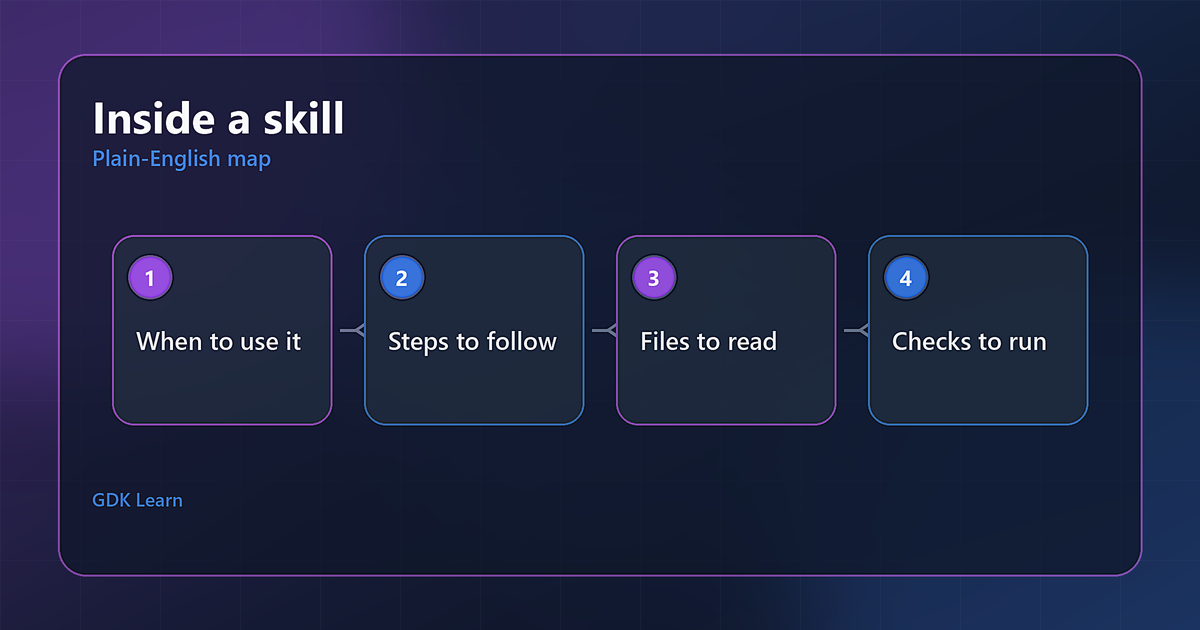
At its smallest, a skill is a folder with one file in it. That file is named SKILL.md, and it holds the instructions. A fuller skill adds supporting pieces around that file: scripts the AI can run, reference documents it can read when it needs detail, and assets like templates.
The two parts of SKILL.md. The top of the file is a short block of information about the skill: its name and a description of what it does and when to use it. Below that is the body, the actual step-by-step instructions the AI follows.
Progressive disclosure. This is the clever part. The AI does not load the whole skill all the time. It always sees a one-line summary of every skill it has, the same way you glance at a table of contents. When a task matches, it opens the full instructions. Only if it needs fine detail does it open the bundled reference files. That layering is why an AI can have a hundred skills installed without drowning in them. It only pays attention to what the job in front of it needs.
The description does the heavy lifting. That one-line summary is the most important part of the whole skill. It is what the AI reads to decide whether to use the skill at all. A vague description ("helps with documents") gets skipped. A specific one that names what the skill does and when to reach for it gets used. Most of whether a skill works comes down to that single line.
How much freedom to give it. A good skill matches how tightly it is written to how fragile the job is. For a task where many approaches work, plain guidance is enough. For a job that has to happen exactly one way every time, the skill spells out the precise steps and leaves no room to improvise. The picture worth keeping: an open field needs only a direction, a narrow bridge with a drop on each side needs exact instructions.
Why skills are worth understanding now
Two things make skills more than a passing feature. First, the format became an open standard, which means a skill written once can be read by a range of AI tools rather than locked to one. The same file travels. The catch worth saying plainly is that the format is shared, but each tool keeps skills in its own folder and may run them a little differently. The portability is real, not perfectly uniform.
Second, skills are how repeatable expertise gets packaged. The knowledge that used to live in one person's head, or in a document nobody reads, becomes something the AI actually applies at the moment it is needed. That is the part that saves a business real time.
The short reality check
A skill does not make an AI smarter. It makes a capable AI consistent at one job, which is usually what you actually wanted. And a skill that worked the day it shipped still needs an owner. Steps change, tools move, the reference doc goes stale. Launched is not handled forever. The teams that get value from skills are the ones who treat them like any other part of the operation, something built well and then kept up.
Short explainer video coming soon.
How this connects to what we build
We build custom skills that package a workflow your team repeats: the intake, the draft, the check, the handoff, written down once so the AI runs it the same careful way every time. We hold every one to the same standard as anything else we build. It has to save time, cut mistakes, or kill a task someone dreads. If it would not, we will tell you a skill is not the answer.