The 30-second version
Most people hear "AI agent" and picture something close to magic. The plain version is calmer than that. You give the agent a goal. It looks at the goal, picks a step, takes that step with a tool, looks at what came back, and picks the next step. It keeps going until the job is done or it hits a limit you set.
That loop is the whole idea. A regular chatbot responds to your message and stops. An agent keeps working toward the goal and chooses its own actions on the way there. One responds. The other does.
A mental model you can keep
Picture a sharp assistant working through a task at a desk. They have the goal written on a sticky note. They have a few tools in reach: a phone to call out, a filing cabinet to pull records, a calculator. They take one action, look at the result, and decide the next one. They keep a notepad so they do not repeat themselves. And for anything risky, like sending money out the door, they check with you first.
The AI is the worker at that desk. Everything around it, the goal, the tools, the loop, the notepad, and the rule about checking first, is the setup that turns a smart responder into something that actually finishes work.
The anatomy: what an agent is made of
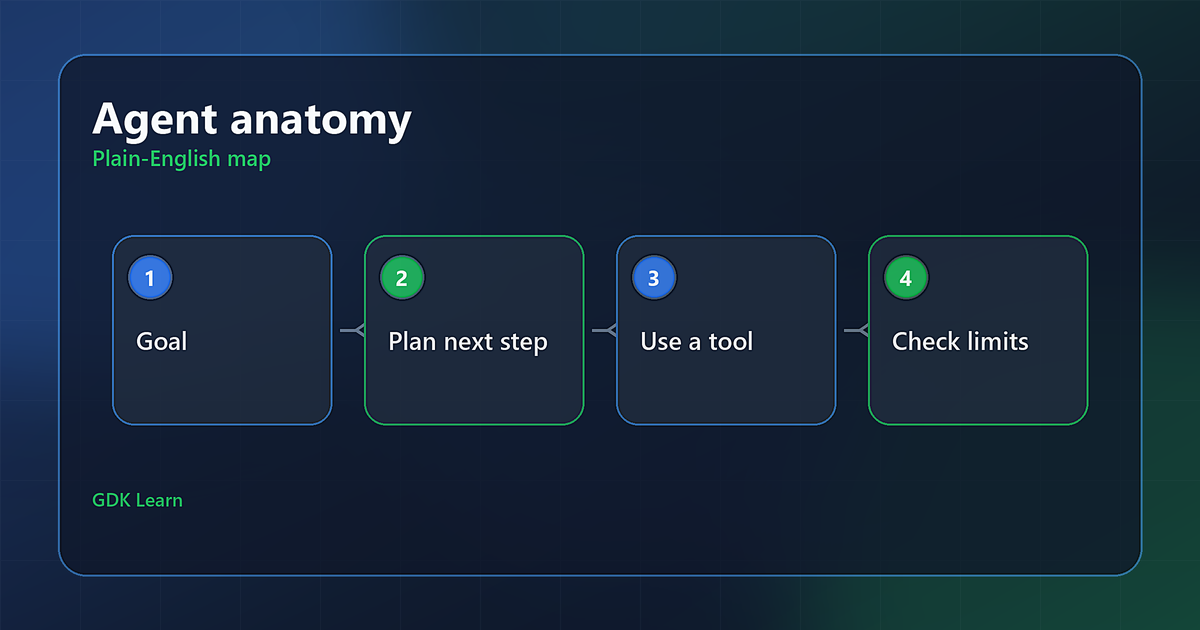
Strip away the buzzwords and an agent is a small number of parts working together.
The goal and instructions. The agent starts with a goal and a set of rules about how to behave, what tools it has, and what limits apply. Weak instructions are the most common reason an agent wanders off and does something useless. Clear ones do most of the work.
Planning. The agent breaks the goal into steps and decides what to do next. Sometimes that is just reacting one step at a time. For longer jobs it can lay out a plan up front and work through it.
Memory. Short-term memory is what the agent is actively holding while it works. Long-term memory is what it can save and pull back later, across steps or even across days. Without memory it forgets what it already tried.
Tool use. Tools are how the agent reaches outside its own head: search the web, read a database, send an email, update a record. The model decides which tool to use and when. Tools are what let it act instead of just talk.
The approval gate. For steps that are expensive or hard to undo, a good agent stops and asks a human first. This is not a weakness. It is the difference between a tool you trust with real work and one you have to babysit.
Where an agent earns its keep, and where it breaks
An agent is the right tool when the steps change every time and something has to read the situation and decide. Research that spans a dozen sources, intake that branches based on the answers, a workflow where step three depends on what step two found. That is agent territory.
When the steps are always the same, you do not need an agent. You need a plain automation that runs the same way every time and costs almost nothing. Reaching for an agent there is like hiring a detective to read you the same weather report every morning.
Here is the honest part most pitches skip. Agents break in specific ways, and you should know them before you trust one with anything that matters.
They wander when the instructions are vague. They will believe almost anything they are told, which means an agent acting on your behalf can be talked into a bad move by a bad input. They cost more and run slower than a simple script, because every step is the model thinking again. And the longer the task, the more chances there are for one wrong turn to snowball. The useful question is not whether this is a real agent. It is how long a task this can handle before a human needs to look.
The short reality check
An agent is not a tiny employee that never sleeps. It is a fast, capable worker that sometimes states a wrong answer with total confidence and will keep going until something stops it. Treat it like a strong new hire on their first week. Give it clear instructions, useful tools, and a rule about when to come ask you. Then check the work that matters before it goes out the door.
How this connects to what we build
We build custom agents for specific business workflows: the repeatable, knowledge-heavy, or consistency-sensitive parts of a job that eat a person's week. The standard we hold every build to is simple. It has to save time, protect revenue, cut mistakes, speed up follow-up, or kill a task you hate doing. If an agent would not do one of those for you, the honest answer is you do not need one yet, and we will tell you so.