The 30-second version
AI tools are free, instant, and genuinely useful, so people use them, often before anyone in charge knows. That creates two everyday risks. Shadow AI is AI being used inside your business without approval or oversight. Data leakage is sensitive information leaving your control by being typed into one of those tools.
Neither involves an attacker. They happen quietly, with good intentions, every day. And for most small businesses they are a bigger real-world risk than the exotic AI attacks that make headlines. The reassuring part: protecting yourself is mostly governance you can do without a security team.
Shadow AI: the tools you don't know about
Shadow AI is the AI version of an old problem. Someone signs up for a free AI tool to get their work done faster, and now company data is flowing into a service nobody vetted, under terms nobody read. It is extremely common, precisely because the tools help and waiting for approval is slow.
The trap is invisibility. You cannot make a sensible decision about a tool you do not know is being used. So the first step is not a policy document. It is simply finding out what AI tools your team actually uses. Ask. People will usually tell you, because they are not hiding anything, they are just getting their work done.
Data leakage: the front door, not the break-in
There is a scary-sounding term, data exfiltration, for an attacker pulling data out of your systems. Data leakage is its everyday cousin, and it is far more common: data walking out the front door on its own. An employee pastes a customer list, a contract, or a chunk of code into a public AI tool to summarize it, and depending on the tool's settings, that content may be stored and may be used to train future models. It is now outside your control.
Three things make this sneaky. It is silent: no alarm goes off when someone pastes a spreadsheet into a chatbot. It is constant: anyone with a browser can do it, daily, meaning no harm. And it crosses compliance lines: personal data and confidential records can end up in a third-party system in ways that break privacy rules or contracts you signed.
How to protect your business, without a security team
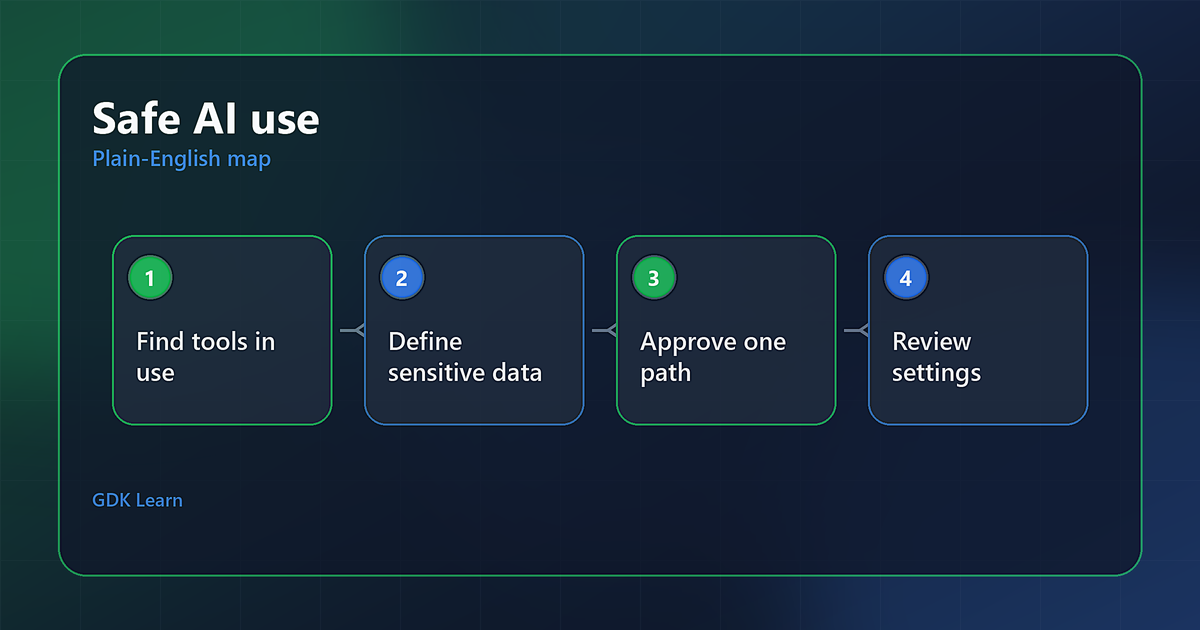
Get visibility first. Find out which AI tools your team uses. You cannot write a useful rule about tools you do not know exist, and this step alone removes most of the surprise.
Write one simple, clear rule. Say plainly what may and may not go into public AI tools: no customer data, no passwords or keys, no contracts, no source code unless it is in an approved tool. A short rule people understand beats a long policy nobody reads.
Give people a sanctioned option. People reach for shadow AI because it helps. Banning AI outright just drives it underground. Offer an approved tool with sensible data settings so the safe path is also the easy path.
Check the data settings. For any AI tool you do approve, check whether it stores your prompts or uses them to train models, and turn that off where you can. Share the minimum, with the tool that needs it, under terms you have actually read.
The short reality check
The headline-grabbing AI attacks are real, and if you are building an AI product you need to take them seriously. But for a normal business just using AI, the thing that quietly exposes the most data is not a hacker. It is an ordinary person using an ordinary tool the right way for the wrong data. That is also the easiest risk to fix, because the cure is mostly awareness and a clear rule, not expensive software. Do the simple things and you have handled most of your real exposure.
Short explainer video coming soon.
How this connects to what we build
When we build AI into a business, keeping data safe is part of the design, not an afterthought: an approved tool, sensible data settings, and clear limits on what the AI can reach. If you are not sure what your team is already putting into AI tools, that is the conversation worth having first, and we are happy to have it with you.