The 30-second version
AI systems are slippery. The same change can make one kind of answer better and another kind worse, and you will not notice if you are only eyeballing a few outputs. An eval replaces the gut feeling with a measurement: you give the AI a set of cases where you know the right answer, run it, and score how it did.
Once you can measure it, you can improve it on purpose. Change a prompt, run the eval, and the number tells you whether you helped or hurt. Without that, every change is a guess dressed up as progress.
A mental model you can keep
Think of an eval as an answer key, not a feeling. A teacher does not grade a stack of tests by skimming one and deciding the class "seems fine." They score each answer against a key. An eval does the same for an AI: a set of questions with known-good answers, and a score for how many the AI got right.
The point of the answer key is that it is honest in a way your impression is not. "It feels better" is how you fool yourself. "It went from getting 7 of 10 right to getting 9 of 10 right" is how you actually know.
How it works, in plain terms
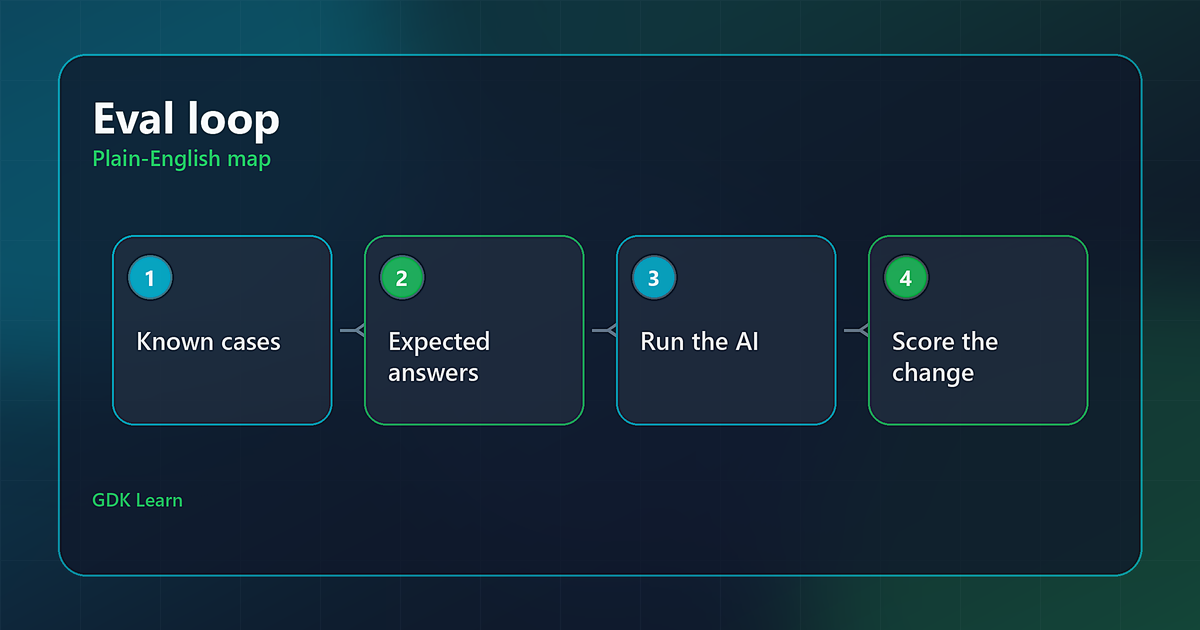
You build a set of test cases that look like the real work: typical questions, tricky edge cases, and the kinds of inputs that tend to break things. For each, you record what a correct answer looks like. That set becomes your answer key.
Then you run the AI against the whole set and score it. Some answers can be checked automatically. Some need a person, or a second AI acting as a grader, to judge quality. You run the eval every time you change the system, so you catch a regression, something that used to work and now fails, before your customers do.
Where evals earn their keep, and where they are overkill
Evals matter most when you are relying on an AI system for something real and repeated, and when "good enough" has to be proven rather than felt. Anything you are about to put in front of customers, or build a process around, deserves an eval, because the cost of it silently getting worse is paid by the people who depend on it.
They are overkill for a one-off, throwaway use of AI where a human is reading every answer anyway. If you are just asking a chatbot a casual question, you are the eval. The discipline matters when the AI runs without someone checking every output.
The short reality check
Evals are the unglamorous part of AI work that separates a tool you can trust from a demo that happened to look good once. The hard truth they enforce is that a thing feeling better and a thing being better are different, and only one of them is measurable. Skipping evals does not make an AI system reliable, it just hides whether it is. The teams that get dependable AI are the ones willing to keep score.
Short explainer video coming soon.
How this connects to what we build
When we build a custom agent or skill, the eval is part of the work, not an afterthought. It is how we prove the thing does its job before you rely on it, and how we keep it working as it changes. An AI tool that has never been measured is one nobody can actually vouch for, and we are not going to hand you one of those.