The 30-second version
Most businesses run on small repetitive handoffs: copy this into that, notify this person, file that record. Workflow automation strings those steps together so they happen on their own. You set up the rule once, and from then on the work just happens when the trigger fires.
The defining trait is that it is predefined. You decide the steps and the order up front, and the automation follows them exactly. It does not think or improvise. That is its strength, not a limitation.
A mental model you can keep
Picture a row of dominoes. You give one a push, the trigger, and the rest fall in the same order every time. Set the dominoes up once and every push produces the same reliable chain.
That is workflow automation. Now picture the contrast: an AI agent is not a row of dominoes, it is a worker who looks at the situation and decides which domino to push next. The automation always does the same thing. The agent decides. Knowing which one a job needs is most of the decision.
How it works, in plain terms
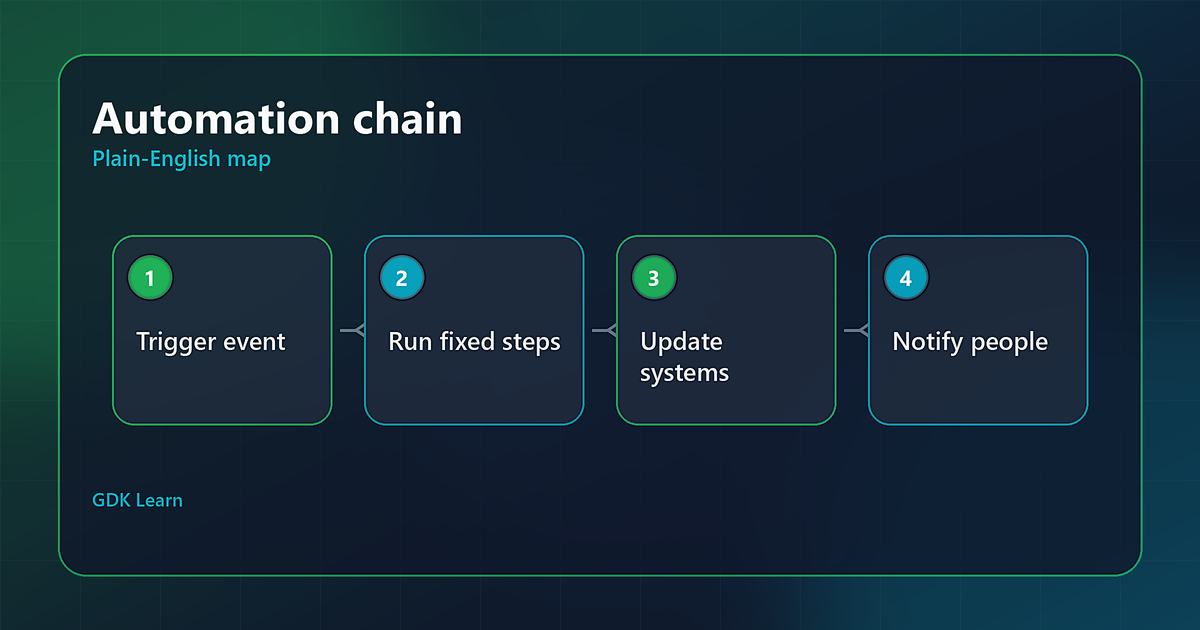
An automation has a trigger and one or more actions. The trigger is the thing that starts it, a new email, a submitted form, a scheduled time. The actions are what happens next, across whatever apps you have connected: add a record, send a message, update a spreadsheet, create an invoice.
Most of this is done with no-code automation platforms, where you connect apps and build the rules visually, no programming required. For a small business, this is often the highest-value, lowest-risk AI-adjacent step available, because it removes real busywork without any of the unpredictability of a full AI agent.
Automation or an AI agent?
Use plain automation when the steps are always the same. If every submitted form should always create the same record and send the same notification, that is a fixed sequence, and a fixed sequence wants an automation: cheaper, faster, and more reliable than anything with AI in it.
You need an AI agent only when the path changes case to case and something has to read the situation and decide. If step three depends on what step two found, or the input is messy and needs judgment, that is agent territory. Reaching for an AI agent on a fixed, repeatable task is overkill, and it adds cost and unpredictability you do not need.
The short reality check
Automation is one of the most underrated wins in business software, precisely because it is boring and reliable. It will not wow anyone in a demo, and that is the point: it does the same correct thing every time without supervision. The mistake is reaching past it for something fancier. Most of the time, the repetitive task eating your week wants a simple automation, not an AI agent.
Short explainer video coming soon.
How this connects to what we build
A lot of the time, the honest answer to "can AI fix this?" is a plain automation, not an agent, and we will tell you when that is the case. When the work genuinely needs judgment that changes each time, that is when an agent earns its place. We build both, and the standard is the same: it has to save time, cut mistakes, or protect revenue.