The 30-second version
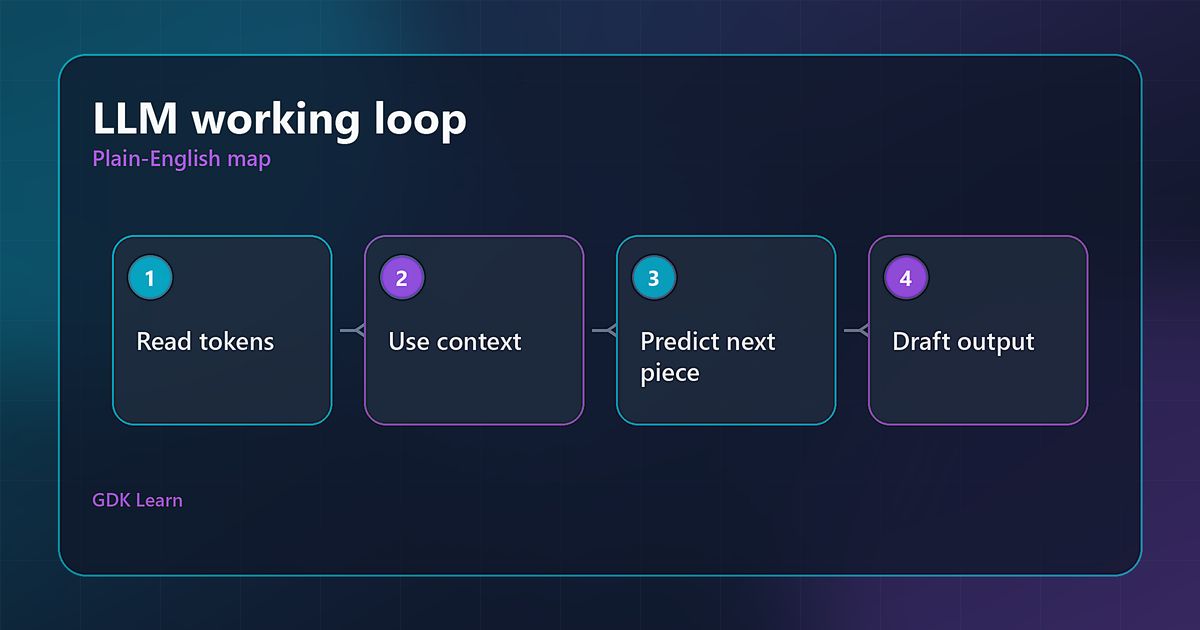
A large language model was trained on a huge amount of text. From all that text it learned the patterns of language well enough to guess what comes next. When you type a question, it is, underneath, predicting the most fitting next chunk of text, then the next, until it has written an answer.
That is the whole trick, and it is more powerful than it sounds. Predicting text well enough turns out to let a model draft an email, summarize a report, explain an idea, or write code. But knowing that this is what it does, prediction rather than looking things up, explains both its strengths and its mistakes.
A mental model you can keep
Think of the next-word suggestion on your phone keyboard, the little bar that guesses the word you are about to type. A large language model is that idea scaled up enormously, trained on far more text and able to predict not just the next word but whole sentences and pages.
The key thing this picture gets right: it predicts, it does not look up. Your phone's keyboard does not "know" facts; it guesses likely text. An LLM is vastly better at guessing, good enough to be useful, but it is still guessing from patterns, not reading from a database of truth. That is why it can be brilliant and wrong in the same breath.
What an LLM is good at, and what it is not
It is good at working with language: drafting, rewriting, summarizing, explaining, translating, and turning messy notes into something clear. It is genuinely useful for the parts of a job that involve producing or transforming text.
It is not a fact database, a calculator, or a search engine. On its own it has no live access to the internet, your files, or today's news, and it can state something false with complete confidence because a plausible-sounding sentence is exactly what it is built to produce. It also has a knowledge cutoff: a rough date after which it has not learned anything new unless it is connected to a tool that can look things up.
Why it makes confident mistakes
Because the model produces the most plausible next text, not the most true text, it will sometimes generate a confident, well-formed answer that is simply wrong. This is called a hallucination, and it is not a bug you can fully prompt away. It is a side effect of how the thing works.
The practical takeaway is not to distrust LLMs, it is to use them where confident-but-sometimes-wrong is fine with a human check, and to be careful where it is not. For anything that matters, you verify the output before you rely on it, the same way you would check a sharp new hire's first week of work.
The short reality check
An LLM is a remarkably capable text engine, not a mind and not an oracle. It does not understand the world the way you do, it does not know what is true, and it will not tell you when it is unsure. Treated as a fast, fluent assistant whose work you check, it saves real time. Treated as a source of guaranteed truth, it will eventually embarrass you. The skill is knowing which is which.
How this connects to what we build
Most of what we build sits on top of these models: agents, skills, and assistants that put a capable text engine to work on a specific job, with the checks and limits that make it trustworthy. Knowing what the model is good at, and where it needs a human, is the difference between AI that helps and AI that quietly causes problems. That judgment is most of the work.