The 30-second version
A prompt is how you tell an AI what job to do, what information to use, what rules to follow, and what a good result looks like. The quality of what you ask sets a ceiling on the quality of what you get back. Vague in, vague out.
Prompt engineering is not about secret magic words. It is the ordinary skill of giving clear instructions, the same skill a good manager uses. Most of the gain comes from a few simple habits, not from tricks.
A mental model you can keep
Think of a prompt as a work order you hand to a sharp but very literal new contractor. If the order says "do something with the kitchen," you will get something, and it probably will not be what you wanted. If the order says what to build, with what materials, by when, and what done looks like, you get useful work.
The AI is that contractor: capable, fast, and willing, but it will do exactly what the order says, not what you meant. Prompt engineering is writing the order so well that what it says and what you meant are the same thing.
The habits that change your results
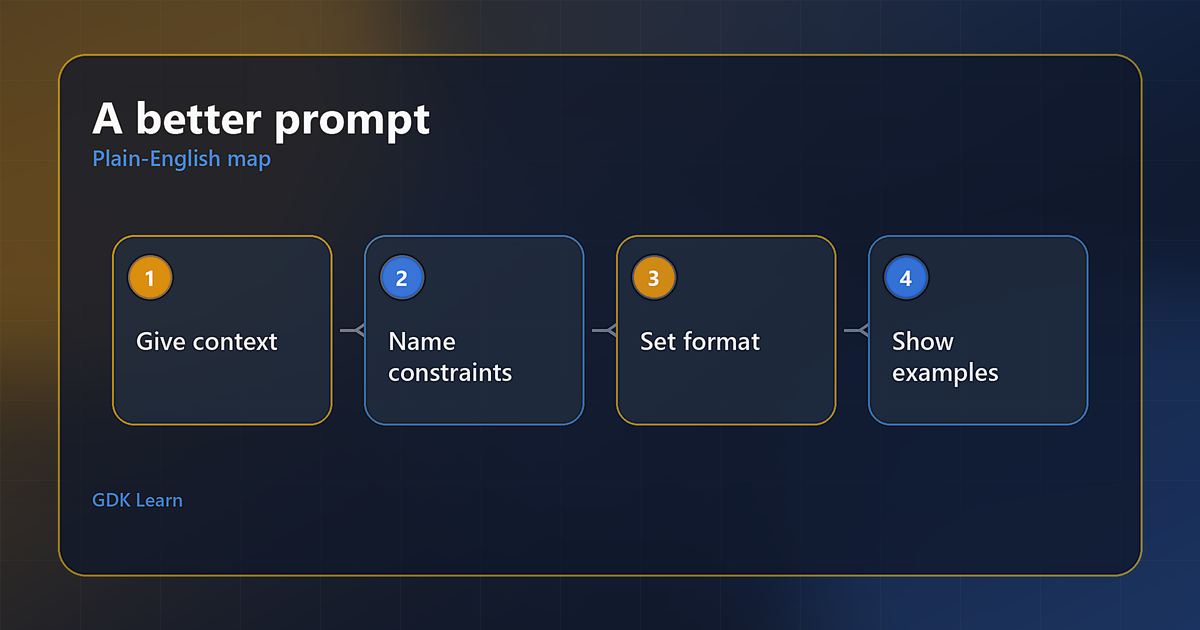
Say what good looks like. Describe the output you want: the format, the length, the tone, who it is for. "Write a friendly two-sentence reply a customer would understand" beats "reply to this."
Give it the context, not just the task. The AI cannot read your mind or your files. Paste in the relevant details, the background, the constraints. The best wording cannot make up for missing information.
Show an example or two. If you have a good one you wrote before, include it. Examples often teach the AI your style faster than a paragraph of instructions does.
For anything with steps, ask it to work through them. For a task that needs a bit of reasoning, asking the AI to think it through step by step tends to improve the answer, the same way asking a person to show their work does.
Where it matters, and where it is overkill
Prompt engineering matters most when you use an AI for the same kind of task repeatedly, or when the output has to meet a standard. A little effort on the wording pays back every time you run it. For one-off casual questions, you do not need to engineer anything; just ask.
And there is a ceiling. When the task is fragile or repeated often enough, a one-off prompt stops being the right tool. That is the moment a skill, a reusable, written-down version of the instructions, beats re-typing a clever prompt every time.
The short reality check
Good prompting makes a capable AI more reliable. It does not make a weak idea into a good one, and it does not let the AI do things it fundamentally cannot. The biggest mistake is treating the prompt as a magic phrase to discover. It is a brief to write clearly. Spend your effort on saying what you actually want, and most of the so-called tricks stop mattering.
Short explainer video coming soon.
How this connects to what we build
When a team relies on AI for the same job over and over, we stop hand-writing prompts and turn the good instructions into a skill: written down once, run the same careful way every time. That is a lot of what we build. If a clear prompt already does the job for you, you do not need us to build anything, and we will say so.