The 30-second version
An AI on its own is sealed off from your world. It cannot read your files, check your calendar, or look something up in your database unless something connects it. Before MCP, every AI app connected to every tool in its own custom way, which meant a tangle of one-off integrations that broke constantly.
MCP is the agreement that fixed that. A tool maker builds one MCP server for their tool, and any MCP-aware AI app can plug into it. One standard, many tools, the same way every time.
A mental model you can keep
Think of how USB-C replaced a drawer full of different chargers. One shape, many devices. You stopped needing a special cable for every gadget.
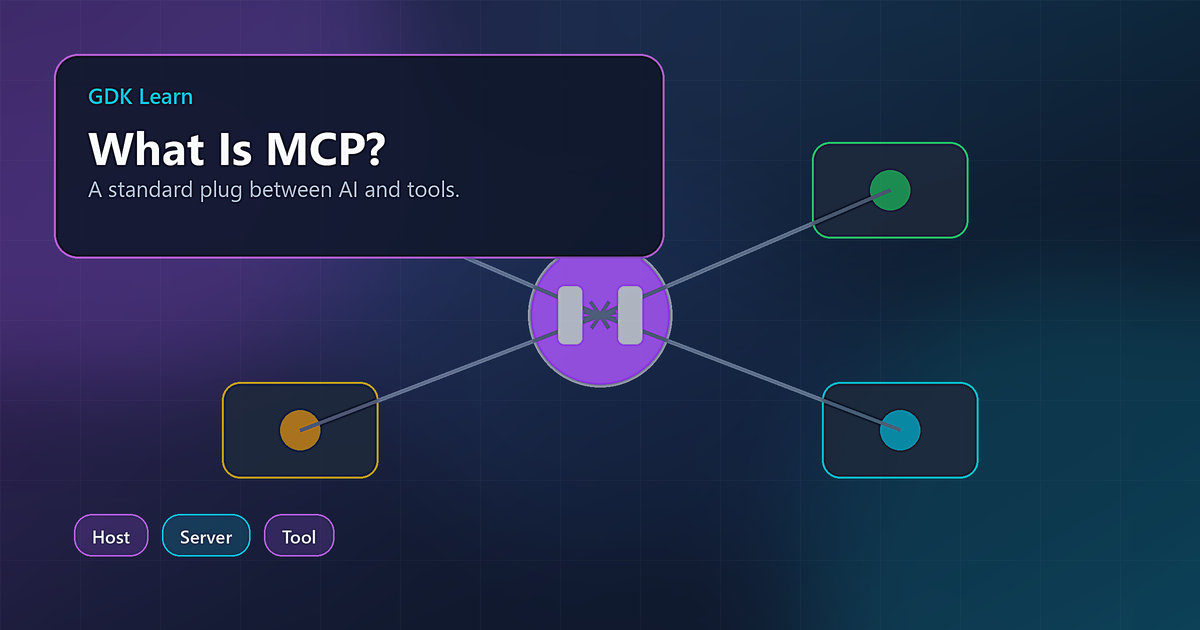
MCP does that for AI. Picture an AI app as a person at a desk surrounded by filing cabinets, phones, and machines, each one normally needing its own special instructions. MCP is a shared language they all agree to speak. Now the person can walk up to any cabinet or machine that also speaks it and use it without a custom manual each time. The AI app is the host, each tool is a server, and MCP is the shared language between them.
How it works, in plain terms
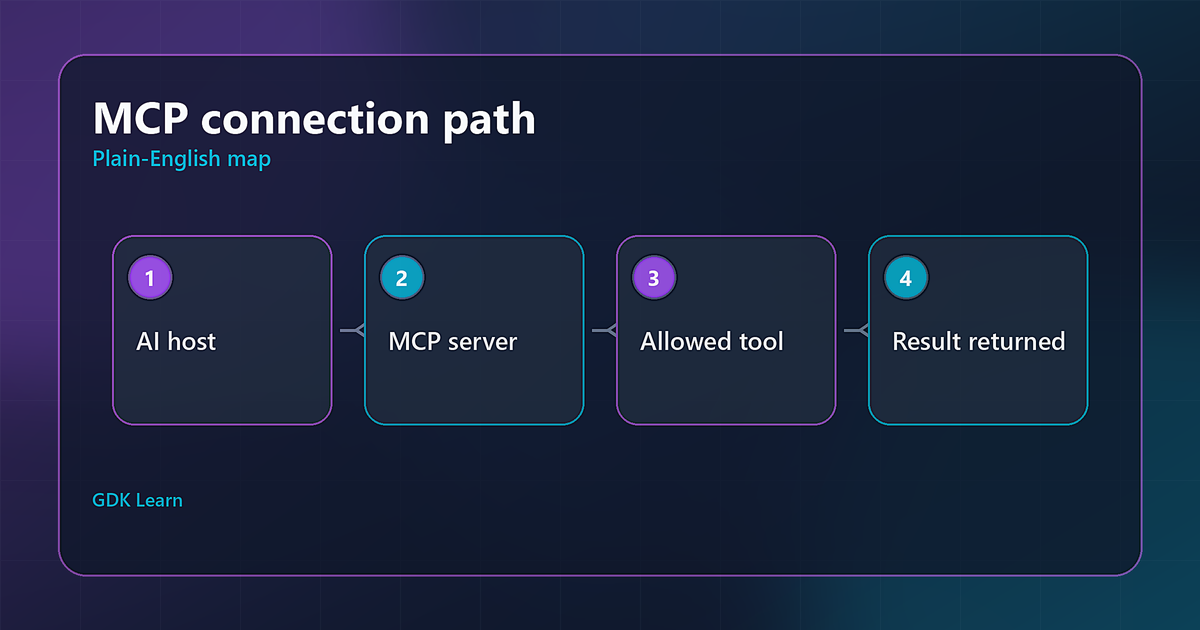
On one side is the AI app you use, the host. On the other side is a tool or data source, wrapped in a small program called an MCP server. The server tells the AI app what it can do, for example "I can search these files" or "I can create a calendar event." When the AI decides it needs that capability, it asks through MCP, the server does the work, and the result comes back.
Because the connector is standard, the same AI app can plug into your calendar, your files, and your database without anyone writing custom glue for each one. And a careful setup keeps a boundary: what a tool returns is information for the AI to use, not a new set of orders it must obey.
Where MCP matters, and where it does not
MCP matters when you want an AI to actually do things in your world: read your documents, update a record, pull live data. It is the plumbing that makes that possible without a brittle custom integration for every connection. It spread fast for exactly this reason.
It does not matter much if all you need is a chatbot that answers from general knowledge and never touches your systems. MCP is about connection, so if there is nothing to connect to, you do not need it. And it is mostly a builder's concern. As a business owner you rarely set up MCP yourself; you just benefit when the AI tools you use can plug into the rest of your stack cleanly.
The short reality check
MCP is a connector standard, not magic. It makes connecting an AI to a tool cleaner and more reusable, which is genuinely valuable, but it does not make the AI smarter or safer on its own. The same care still applies: an AI that can reach your tools needs limits on what it is allowed to do with them. The standard solves the plug. It does not solve judgment.
Short explainer video coming soon.
How this connects to what we build
When we build a custom agent that has to touch your real tools, MCP is often how we connect it cleanly instead of with brittle one-off glue. The point is never the connector for its own sake. It is an AI that does a real job in your actual systems, safely and reliably. If a simpler connection does the job, we use that instead.