Digital roof pitch gauge and inclinometer app in your pocket
The pitch gauge in the truck reads degrees. Pitch Please reads the phone's motion sensors the same way and reports the answer as X:12 with the degrees beside it, then saves the screen so the reading is on record. Rest it on the slope and read. To go the other way, from a rise and run on paper to the pitch and angle, use the roof pitch calculator.


Direct Mode is the inclinometer
Hold the phone in landscape and lay its long edge along the slope, in line with the direction the roof falls. Direct Mode reads the angle straight from the device's motion sensors, the same principle as a digital inclinometer or clinometer, and shows it as X:12 pitch with the angle in degrees. A stability badge tells you when the reading has settled, and saving writes the measurement screen to your photo library.
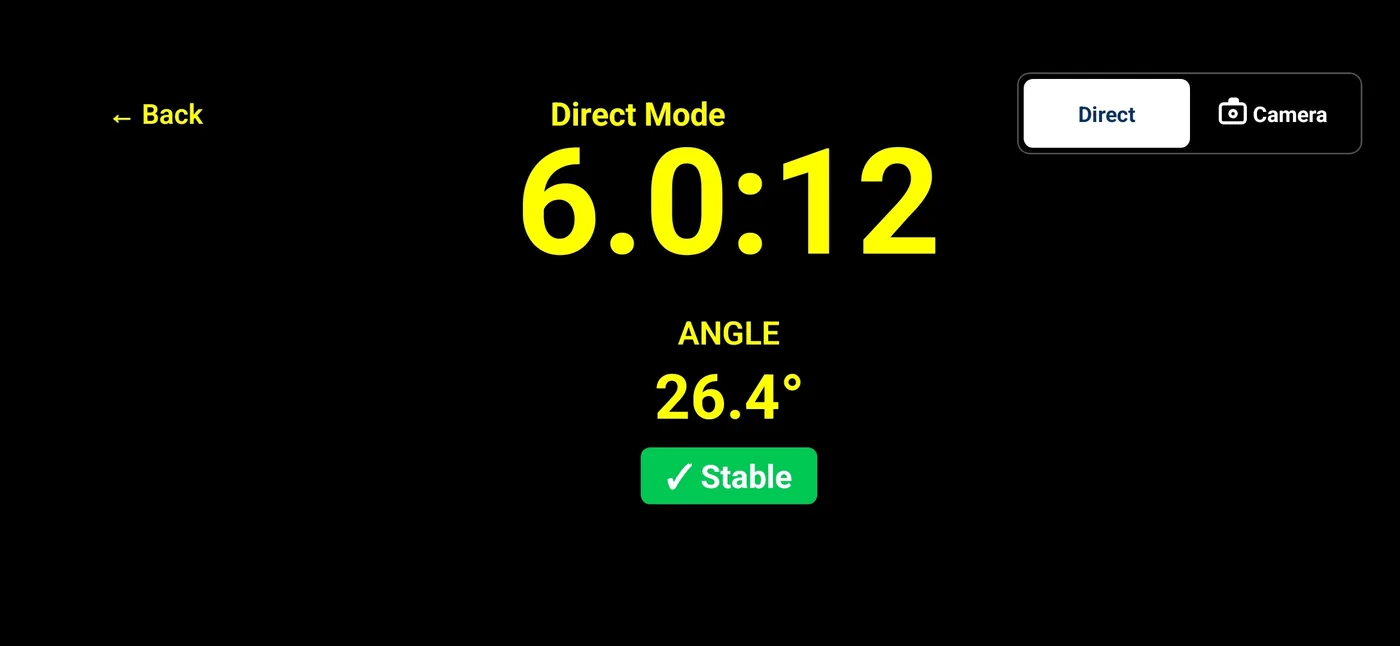
Against the physical pitch gauge
None of these tools is wrong. The question is what you get for the reach into the bag.
| Tool | Readout | Record of the reading | Needs to touch the roof |
|---|---|---|---|
| Dial or digital pitch gauge | Degrees, or X:12 on some dials | None; you write it down | Yes |
| Speed square and level | Rise per 12 read off the square | None; you write it down | Yes |
| Generic angle or level app | Degrees | Usually a screenshot with no context | Yes |
| Pitch Please, Direct Mode | X:12 with degrees, or slope units | Saved measurement screen with the value on it | Yes |
| Pitch Please, Camera Mode | X:12 with degrees, or slope units | Photo of the roof with the guide line and value on it | No |
The last row is the one the physical gauge cannot do at all. Reading a slope you cannot reach is covered on the Camera Mode page.
Getting a repeatable reading
Rest the phone flat on the slope
Direct Mode measures the tilt of the device itself, so the reading is only as good as the contact. Lay the long edge flat along the direction the roof falls, not across it, and keep it still.
Take a second reading
If a number looks wrong, lift the phone and place it again rather than trusting one placement. Two placements that agree are better evidence than one that does not.
Wait for the stability badge
The reading is live. The badge goes green when the sensors have settled, and that is the number to save, not the one that flashed while you were still placing the phone.
Keep the screen on
Settings has a keep-screen-on option for Direct Mode and haptic feedback, so the phone does not lock mid-reading and you can feel the confirmation without looking away from the roof.
An angle finder for more than roofs
Anything with a slope reads the same way: a deck, a shed roof, a ramp, a gutter run, a driveway apron, a small addition. Rest the phone on it and read the angle. The X:12 readout is the roofing convention, but the degrees are there for everything else, and the saved image goes in the job file either way. The roofing-specific math, including the pitch multiplier for material orders, is on the page for roofers and contractors.
Frequently asked questions
Is Pitch Please an inclinometer or a clinometer?
Both words describe the same job: reading an angle against level. Pitch Please does that with the phone's motion sensors in Direct Mode, and adds the roofing X:12 readout, a stability indicator, and a saved image of the measurement.
Why not just use a generic level or angle app?
A generic angle app gives you degrees. Roofing is written as rise over 12, so you would convert every reading by hand. Pitch Please shows X:12 and degrees together, and saves a photo so the number is not just a memory.
Does the phone have to touch the roof?
For Direct Mode, yes: the app measures the angle of the device itself. If you cannot reach the surface, switch to Camera Mode and read the pitch from the ground instead.
Get Pitch Please
Available now on the Apple App Store and Google Play. Current pricing and device compatibility are on the store listings.
Related: how it compares as a Pitch Gauge alternative, device support for iPhone and Android, and the main Pitch Please page.
Found something on this page that does not match the app? Tell us and we will fix it.